Austrian Trade Union Federation (ÖGB)
Project „Labour Relations in the Danube Region“
mitay20 – stock.adobe.com
Project Description
Labour Relations in the Danube Region (LRDR) strengthens young workers in the Danube region through education, networking, and dialogue. The project provides practical knowledge about labor rights, promotes exchanges between social partners, and builds cross-border networks.
A key challenge is the low visibility of trade union work among young people. Therefore, the project focuses on direct contact at educational institutions, clear and easily understandable communication, and topics particularly relevant for entering the workforce. In this way, it becomes clear that trade unions offer concrete support and guidance on current issues in the world of work.
Project Goals
The project pursues several interlinked objectives:
- Raising awareness of labor rights among young people: This includes basic aspects such as employment contracts and working hours, as well as current topics like platform work and the use of artificial intelligence.
- Promoting dialogue between young workers and employer representatives: Moderated dialogue formats aim to develop joint solutions to challenges.
- Cross-border networking of young trade unionists: This enables the exchange of experiences between partner countries.
- Promoting young women in leadership roles within trade union structures: All coordinator positions are preferably filled by female candidates under 35.
Project Activities
- Workshops at educational institutions: Interactive workshops are conducted in all partner countries. The 2–3-hour sessions provide practical knowledge on labor rights and social partnership. The workshops are led by union coordinators and adapted to the respective national context.
- Network of young social partners: The project establishes a dialogue platform bringing together young trade unionists and employer representatives under 40. National dialogue meetings develop joint positions on fair working conditions.
- Study trip to Brussels: Coordinators from all partner countries visit European institutions in Brussels. The trip serves both to provide knowledge about EU labor standards and to strengthen cross-border networking.
- Publications and public relations: The project produces two brochures: “Labor and Social Rights for Young Professionals” and “The EU and Young Workers.” In addition, a report analyzing the situation of young workers in the partner countries is published. The accompanying social media campaign shares insights from the workshops, informs about labor rights, and makes the project results accessible to a wider audience.
The project concludes with a conference where the results are presented and experiences from the project are shared and discussed with partner organizations and other interested participants.
Partner Countries
Albania, Bosnia and Herzegovina, Moldova, Montenegro, Serbia
Funded by the Federal Ministry of Labour, Social Affairs, Health, Care and Consumer Protection.
Project Partners
Albanian Trade Union Confederation (KSSH/CTUA)
Confederation of Independent Trade Unions of Bosnia and Herzegovina (SSSBiH)

Trade Unions in the Republic of Moldova (CNSM)
Union of Free Trade Unions of Montenegro (USSCG/UFTUM)
Confederation of Trade Unions of Montenegro (SSCG/CTUM)
Confederation of Autonomous Trade Unions of Serbia (SSSS/CATUS)
Trade Union Confederation Nezavisnost Serbia (TUC Nezavisnost)
Activities
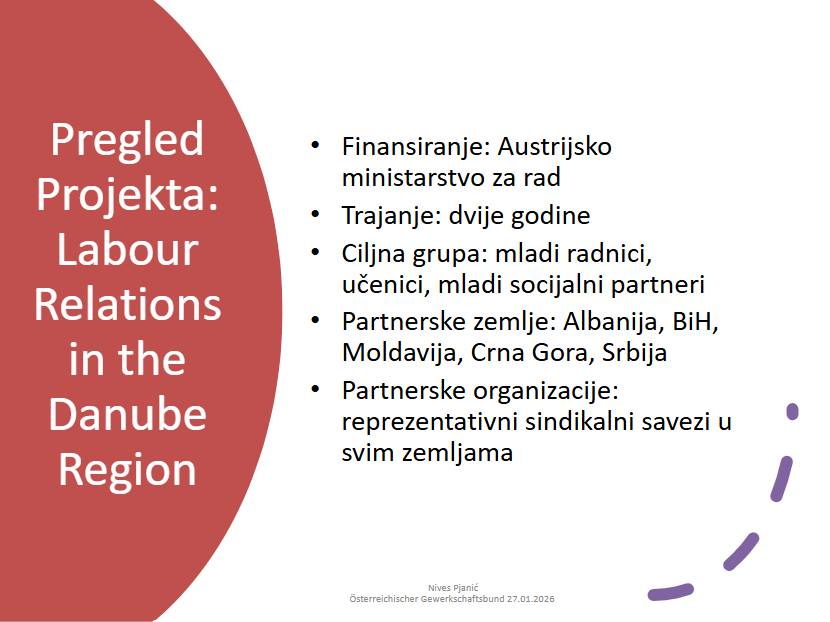
Meeting with Serbian and Montenegrin partner unions – January 27, 2026
On January 27, the CETUN conference took place in the Riverböx of the ÖGB. Since four partner unions of the LRDR project participated, this opportunity was used to organize a follow-up meeting after the conference.
Representatives from the Serbian unions CATUS and Nezavisnost, including Čedanka Andrić, Vice President of the ETUC, as well as representatives from the Montenegrin unions SSCG and USSCG, attended the meeting.
The LRDR project was presented in B/C/S by the project management, goals were explained, and planned activities were discussed. Further details were then addressed, and open questions clarified. Particular attention was paid to the implementation of school workshops in the partner countries.
The meeting provided an excellent opportunity for personal exchange, to deepen cooperation, and to ensure that project implementation can start smoothly in all partner countries.